









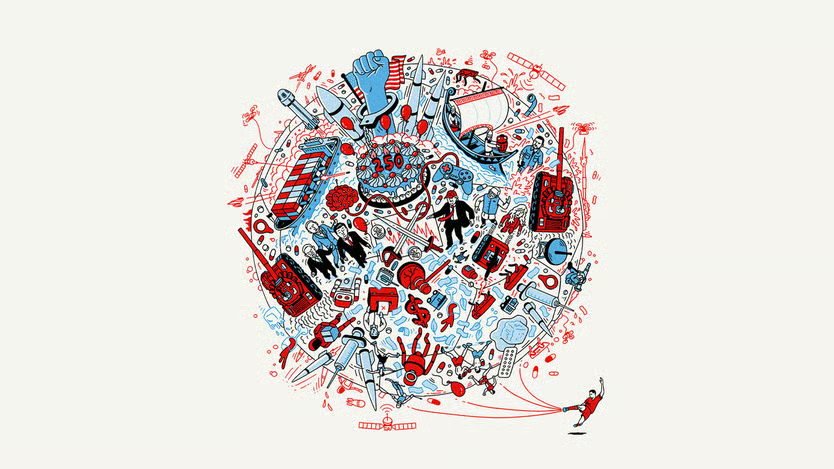
Every year, The Economist releases a symbolic illustration forecasting the world. The Economist 2026 cover is not random artwork — it is a carefully constructed visual manifesto. Each icon, color, and object represents a possible future trend, threat, or transformation shaping the coming years.
This cover is especially dense, suggesting global instability, rapid technological acceleration, climate stress, and geopolitical power struggles reaching a peak by 2026.
Global Power & Geopolitics
At the center, overlapping figures, weapons, flags, and control mechanisms suggest a fragmented world order.
-
Military aircraft, missiles, and drones imply ongoing and future conflicts, signaling that wars will remain unresolved rather than ending decisively.
-
Surveillance cameras and control panels hint at stronger state monitoring, digital tracking, and authoritarian tools.
-
Crowded human figures moving in different directions represent political polarization and divided societies.
This reflects The Economist’s predictions about future happenings: a world where power is contested, not centralized.
Technology, AI & Automation
Technology dominates the image.
-
Robotic arms, chips, circuit lines, and screens represent AI’s expansion into every sector.
-
Human-machine hybrids hint at blurred boundaries between people and technology.
-
Disconnected cables and chaotic wiring suggest tech growth without full regulation, increasing risks.
The message is clear: AI will advance faster than governance, creating opportunity and instability at the same time.
Economic Signals & Financial Stress
Scattered throughout the image are symbols tied to money and trade:
-
Broken graphs and unstable arrows point to volatile markets.
-
Currency symbols mixed with machines suggest automation replacing traditional jobs.
-
Containers, factories, and logistics elements imply strained global supply chains.
The Economist 2026 predictions suggest that economic uncertainty will be the norm, not the exception.
Climate Change & Environmental Pressure
Environmental warnings are everywhere:
-
Cracked land, storms, rising lines, and melting shapes hint at climate breakdown.
-
Water-related symbols and sinking structures point toward floods, sea-level rise, and water scarcity.
-
Animals and nature trapped inside machinery suggest humans are pushing ecosystems past recovery.
The cover implies that climate issues will no longer be “future problems” — they will define daily life.
Health, Biology & Human Survival
Biological symbols are subtly embedded:
-
DNA strands, lab equipment, and medical icons hint at genetic engineering, pandemics, and biotech breakthroughs.
-
Masks and fragmented human faces suggest lingering global health anxieties.
-
Red accents around biology symbolize risk — not just progress.
This aligns with The Economist’s long-standing view that science will advance faster than ethical consensus.
Social Unrest & Cultural Shifts
Human emotion is everywhere:
-
Protesting figures, raised hands, and megaphones reflect unrest and mass movements.
-
Disconnected individuals surrounded by noise suggest loneliness in hyper-connected societies.
-
Entertainment icons mixed with chaos imply distraction amid crisis.
Societies are portrayed as overstimulated, underprepared, and emotionally exhausted.
The Chaotic Circular Design: A World Without Balance
The entire illustration forms a closed, chaotic circle, symbolizing:
-
No clear beginning or end
-
Systems feeding into each other
-
Crises are overlapping instead of resolving
This visual choice reinforces the idea that 2026 will be defined by complexity rather than clarity.
What The Economist Is Really Saying
The Economist’s predictions about future happenings are not about certainty — they are warnings.
The cover suggests:
-
No single global leader
-
Technology outpacing ethics
-
Climate becoming unavoidable
-
Economies staying fragile
-
Humans adapting under pressure
In short, the future will be survivable, but uncomfortable.
Final Thought
The Economist 2026 cover doesn’t promise collapse — but it clearly warns against complacency. The future it sketches is crowded, loud, unstable, and fast-moving, demanding adaptation from everyone.
FAQs
What are The Economist 2026 predictions mainly about?
They focus on geopolitical instability, AI dominance, climate crisis escalation, economic uncertainty, and social fragmentation.
Is The Economist 2026 cover symbolic or literal?
It is symbolic. Each element represents trends, not specific events, allowing multiple interpretations based on global developments.
How accurate have The Economist’s prediction covers been historically?
Historically, analysts estimate that around 65–75% of major themes shown on past Economist covers eventually materialize in some form. The accuracy is higher for trends than for exact events.
How many times have The Economist prediction covers proven right?
Across multiple decades, the majority of recurring themes — such as financial crises, technological disruption, geopolitical tensions, and climate urgency — have repeatedly proven correct, though often in unexpected ways.
Should the Economist 2026 cover be taken as a warning?
Yes. It’s best viewed as a strategic caution, encouraging governments, businesses, and individuals to prepare rather than predict exact outcomes.